


 Destination Anywhere
Van electrical
Van Electrical Systems for Real Trips
Build a van power plan around your daily energy needs, charging opportunities, and the appliances that change everything.
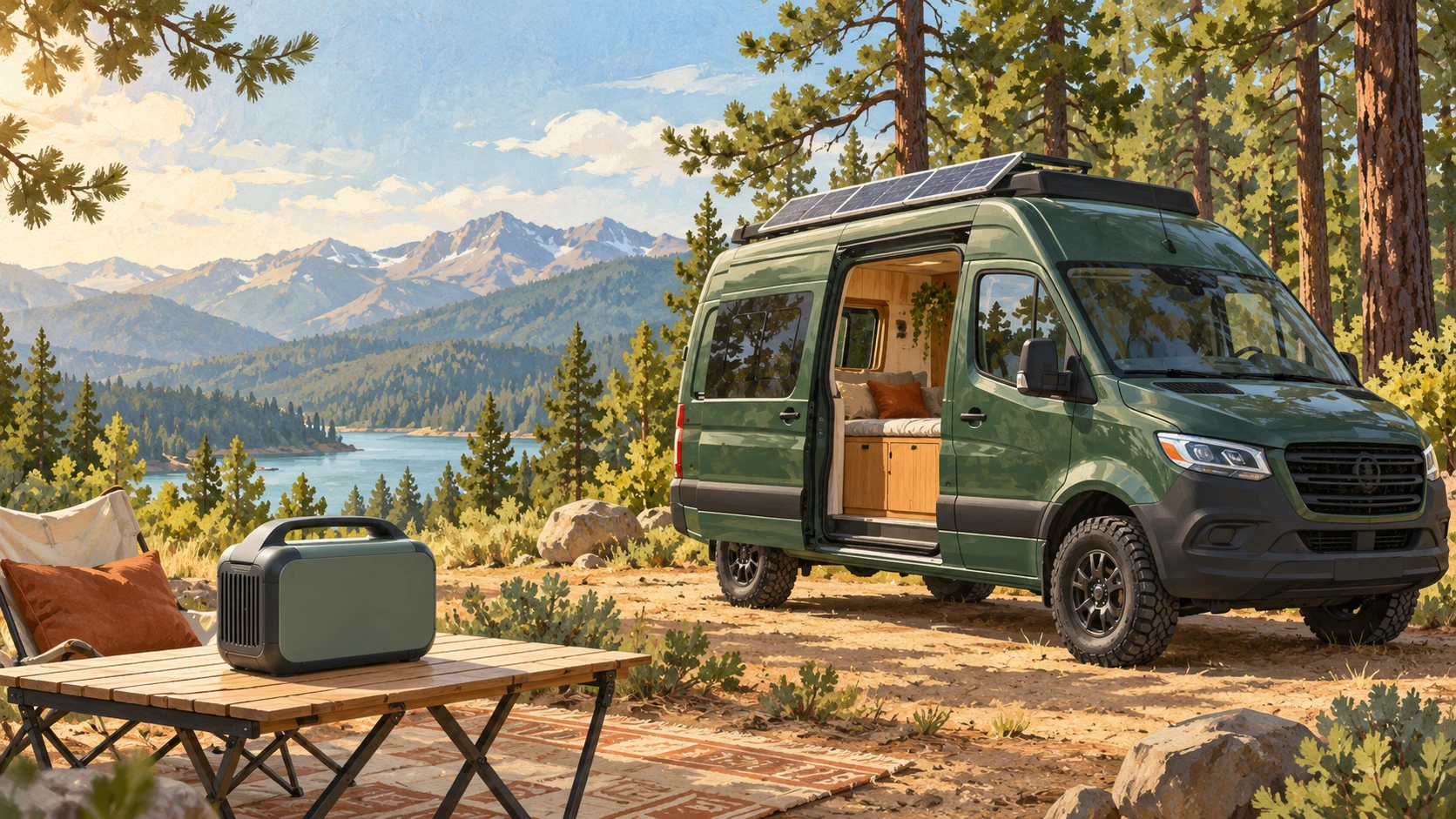
A useful van electrical system starts with an ordinary day: keeping food cold, running the fan, charging a laptop, and making dinner. Write that day down before shopping for batteries. The right system is the one that supports your trips, including the cloudy afternoon when the van stays parked.
This guide is a planning framework for a U.S.-style camper van, with short explainers for the decisions that deserve a closer look. It is not a wiring manual. Have a qualified vehicle electrical professional review the final design, installation, protection, and commissioning.
Portable power or a permanent build
_(43467687445).jpg)
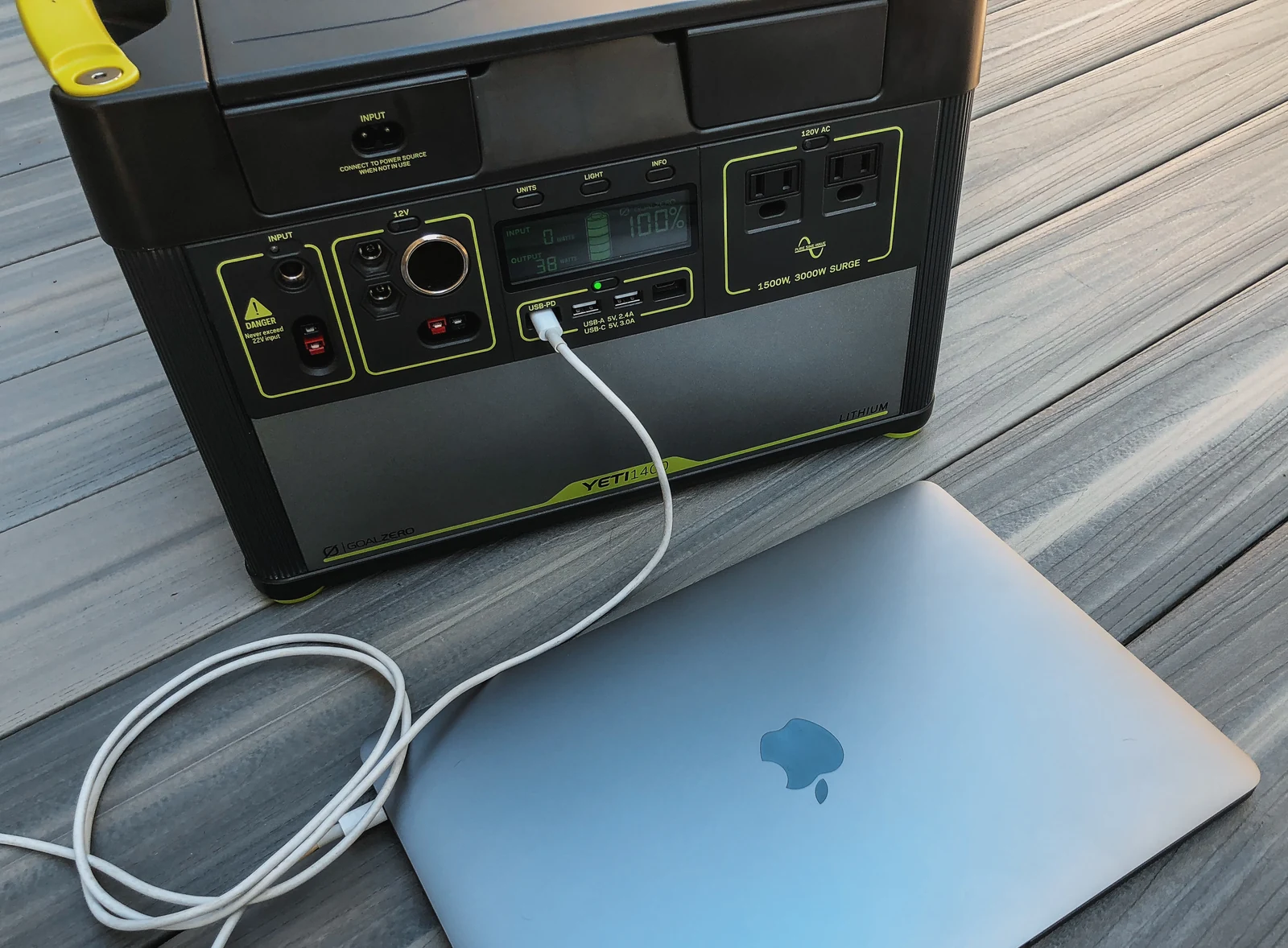
A standalone power station can be a sensible first option for a simple van with modest loads. A permanent house system offers more design freedom for built-in appliances and demanding use. The Explorer 1500 discussed in TreXcursion's camp-kitchen story is a useful simple-build example; it is not a template for every van, and Jackery's other models should be judged individually.
Compare daily Wh, peak output, charging speed, and DC-port limits before choosing either approach. Electric cooking, hot water, and A/C can quickly change the answer. A hybrid can also work: permanent power for built-in essentials, with a separate portable unit for a removable camp kitchen. Read the full portable power station versus permanent battery comparison.
Start with power and energy
Watts, abbreviated W, describe power at a moment. Watt-hours, Wh, describe energy over time. A device averaging 30 W for four hours consumes 120 Wh. A 1,500 W appliance running for six minutes consumes 150 Wh. Both numbers matter: the first helps estimate battery capacity; the second appliance's high instantaneous draw helps determine equipment ratings.
Battery amp-hours need a voltage attached. A nominal 12.8 V, 200 Ah battery stores approximately 2,560 Wh before accounting for the chosen operating window and other limitations. A 24 V, 200 Ah bank contains about twice the nominal energy of a 12 V, 200 Ah bank. Comparing Ah alone can mislead.
In everyday conversation, household outlets are sometimes called “110 volt.” This series uses 120 V AC for common U.S. household-style power. The house battery usually supplies DC. An inverter converts that battery energy to AC; a compatible shore-power charger converts incoming AC into battery charging power.
An illustrative daily energy budget
The following is a teaching example, not a claim about typical appliance consumption. DC entries represent assumed battery-side averages, including associated conversion where needed. Replace every assumption with your equipment's specifications and measured use.
| Load | Assumed use | Daily battery energy |
|---|---|---|
| Compressor fridge | 20 W average over 24 hours | 480 Wh |
| Ventilation fan | 15 W for 8 hours | 120 Wh |
| LED lighting | 8 W for 5 hours | 40 Wh |
| Water pump | 48 W for 0.25 hour | 12 Wh |
| Phones and small USB devices | Combined daily allowance | 60 Wh |
| Laptop on AC | 60 W for 3 hours, at assumed 90% inverter efficiency | 200 Wh |
| Inverter idle outside laptop use | 8 W for 9 hours | 72 Wh |
| Total | 984 Wh |
The laptop uses 180 Wh on the AC side; 180 divided by 0.90 gives 200 Wh from the battery. The separate 72 Wh idle allowance covers only the nine hours when the inverter is on without that load. It is off for the remaining twelve hours. Real efficiency varies with load; use measured battery-side consumption when possible.
Two identical days require 1,968 Wh. Add an illustrative 20% planning margin and the target becomes 2,361.6 Wh. At an assumed 80% usable operating window, a 12.8 V, 200 Ah bank provides 2,048 Wh, below that two-day target. A 300 Ah bank provides 3,072 Wh under the same assumption. That arithmetic does not establish a purchase recommendation: temperature, aging, discharge limits, existing loads, and charging all matter.
This example excludes cabin heating, electric cooking, air conditioning, an always-on router, and entertainment beyond the laptop. Add your actual versions before choosing equipment.
Choose batteries by usable energy
A house battery should be selected for repeated service loads, rather than borrowed from the vehicle's starting duties. Deep-cycle lead-acid designs include flooded and AGM options. Compare complete installed weight, space, maintenance, charging requirements, and warranted operating limits. Trojan's battery selection guide explains the difference between starting and deep-cycle use.
Lithium iron phosphate, or LiFePO4, is another house-battery option. Its usable capacity and permissible current depend on the specific battery and battery management system. Do not turn a planning assumption such as 80% usable energy into a universal chemistry rule.
Cold charging needs particular care. Follow the battery manufacturer's temperature limits and verify that all charging paths respect them. A heated enclosure or a “self-heating” label is not permission to charge cold cells outside the specified conditions. Victron Lithium NG operating limits. Read the battery explainer.
Plan how the energy comes back
There are three common charging opportunities to assess: driving, sunshine, and an approved shore-power connection. Consider the actual itinerary. Frequent driving supports a different design from four nights parked beneath trees.
A compatible DC-to-DC charger regulates charging from the vehicle system. Its rating is not a promise that the alternator has that much spare capacity under all conditions. Vehicle loads, alternator temperature, engine speed, and manufacturer requirements belong in the review. Explore DC-to-DC charging.
Solar earns its place when the roof, parking, and season cooperate. For illustration, a 400 W array receiving four equivalent peak-sun hours with an assumed 75% net yield contributes 1,200 Wh. At two peak-sun hours, the same calculation gives 600 Wh. These are hypothetical scenarios, not a forecast for your campsite.
Evaluate the destination and month, then allow for van-specific shade and roof geometry. NREL's PVWatts calculator offers location-based estimates, but its grid-connected model is not a complete mobile battery-system simulation. Read the solar explainer.
Keep ordinary loads simple
Lights, pumps, ventilation, and many compressor fridges can run from compatible DC circuits. Phones and some laptops can use appropriately rated DC USB charging. Household-style appliances need AC, whether supplied through an inverter or a correctly designed shore-power system.
Choose the inverter after listing what must operate simultaneously. A cooktop and kettle used together create a different requirement from either one used alone. Check continuous watts, startup demands, temperature derating, battery current capability, and idle consumption. Inverter specifications may also list VA, which should not be treated as interchangeable with watts. See inverter sizing and DC versus AC components and budget.
A larger inverter cannot add energy to a small battery. It only increases the potential rate of withdrawal. The charger, battery, distribution, and protection must remain compatible as a system.
Cooking and food storage
Electric cooking is convenient, but needs its own line in the budget. An illustrative cooktop averaging 1,200 W for twenty minutes uses 400 Wh on AC, or about 444 Wh from a battery at assumed 90% inverter efficiency. That single session increases the example's daily total by almost half.
Gas cooking shifts much of that demand into fuel storage and combustion safety. Use appliances only in locations and installations approved by their manufacturer. Outdoor-only camping stoves stay outdoors. Compare cooking choices.
For food, budget continuous availability rather than assuming the fridge runs only while you drive. Verify temperature with an appliance thermometer; USDA recommends a refrigerator temperature of 40°F or below. A cooler can also work when its cold source and handling maintain safe temperatures. Plan refrigeration and food storage.
Cooling and heating change the scale
Air conditioning deserves a separate overnight calculation. If an AC unit averages 800 W of electrical input for six hours, it needs 4,800 Wh at the appliance. At assumed 90% inverter efficiency, battery demand is about 5,333 Wh, before the fridge or any other loads. A DC unit avoids that particular inverter conversion, but still needs substantial stored energy.
Cooling capacity in BTU per hour or thermal watts is not electrical consumption. A model's headline cooling output cannot be inserted into a battery budget as its input draw. Read the A/C reality check.
Resistance heat has a similar energy challenge: 1,000 W for eight hours is 8,000 Wh before inverter losses. A properly installed fuel-fired heater draws electrical power for its own operation while obtaining most heating energy from fuel. Account for startup and shutdown requirements as well as running consumption. Compare heating approaches.
Do not use a cooking stove to heat the cabin. Maintain appropriate CO and smoke alarms. Portable generators must operate outdoors, away from openings and occupied vehicles. CDC's home-safety guidance specifies more than twenty feet from the home, doors, and windows; never run one inside a van, garage, or other enclosed space. Follow the equipment instructions and campsite rules. Sources: CPSC portable heaters and camping equipment; CDC generator safety.
Spend on the complete installation
Prepare a cost worksheet with batteries, charging, inverter or inverter-charger, distribution, protective devices, monitoring, mounting, cabling, ventilation, professional labor, and testing. Add ongoing fuel, campsite electricity, or replacement costs where relevant. Obtain current quotes rather than trusting a parts-only headline budget.
Choose a few features you genuinely need off-grid. Restricting high-draw appliances to shore power may suit one traveler; another may prioritize battery-powered cooking. Always-on communications also belong in the decision: a modest continuous load can consume more daily energy than a short appliance session. Budget entertainment and charging.
Before the first remote trip, test the finished system in a controlled setting. Record a full day's battery energy use, verify charging under realistic conditions, and practice reducing nonessential loads. Keep an alternative plan for food safety, temperature, and reaching reliable power. A measured, maintainable system makes those decisions much easier.
For the next layer of planning, use the shore power checklist, energy audit, and professional safety review questions.